
Casting defect repair is a persistent challenge across many manufacturing industries. Traditional arc welding methods rely on a shrinking pool of skilled welders, have limitations when applied to difficult-to-weld alloys, and become impractical for large or complex repairs, particularly as industries push toward gigacasting. When defects can’t be repaired, parts are scrapped and recast, driving up cost and lead time.
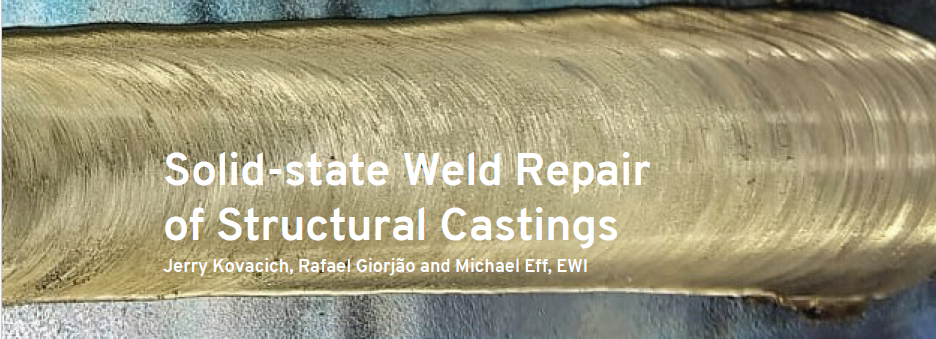
In this new paper, EWI engineers Jerry Kovacich, Rafael Giorjao, and Michael Eff investigate additive friction stir deposition (AFSD) as an automated, solid-state alternative for repairing structural castings across a range of alloys. Drawing on hands-on process development and mechanical testing with two common casting alloys — A380 aluminum and C95500 nickel aluminum bronze (NAB) — the authors demonstrate how AFSD avoids the fundamental limitations of fusion welding while delivering deposit properties that meet or exceed casting material requirements.
Complete this form to download the paper:
Read the full paper to discover:
- Why traditional arc welding repair is increasingly impractical for structural castings
- How AFSD eliminates hot cracking and porosity concerns inherent to fusion welding
- Mechanical property results for AFSD-deposited NAB, including yield and tensile strength exceeding heat-treated cast material requirements
- How AFSD produces dense, defect-free deposits even in highly porous base material
- Implications for gigacasting repair and broader structural casting applications
To access the full paper for FREE, complete the form on this page.
To learn more, contact Jerry Kovacich, Applications Engineer, at [email protected].