
In 2009, a workshop was held at NSF headquarters in Arlington, Virginia, to form a roadmap for Additive Manufacturing (AM) research for the next 10-12 years. That effort focused on identifying possibilities for development in design, process modeling and control, materials, biomedical applications, energy and sustainability, education, and development efforts in the overall AM community. The resulting assessment identified many opportunities for these technologies if investments are made to continue to advance the state of the art.
Based on the 2009 roadmap, EWI organized an Additive Manufacturing Consortium (AMC) to bring together key partners in the U.S. AM community. The AMC has been operating continuously since early 2010 and now consists of 27 member and partner organizations, representing industry members, government agencies, other non-profit research organizations, and key universities active in AM. The mission of the AMC is to bring together a diverse group of practitioners and stakeholders that together accelerate the innovation in AM technologies to move them into the mainstream of manufacturing technology from their present emerging position. The AMC members and partners have identified a list of the five highest priority technical topics that if improved would significantly move the field forward:
- Material property databases
- Process model compensation for distortion / first time accuracy
- Process sensing & control and non-destructive evaluation
- Clear and affordable paths to certification and qualification
- Bigger, faster and more capable OEM equipment
Framework for AM Technology Development
AM is opening up new possibilities for low-cost manufacturing and novel assemblies that cannot be fabricated using current technologies. Around the world, this is generating a great deal of enthusiasm for future high-value manufacturing applications. Currently, there are niche applications particularly in the medical field (and to a lesser extent aerospace) where parts made using polymer AM and some metals are being put into initial in-service evaluation. To meet the full potential of these processes, continued development is essential to make the machines more robust for full manufacturing readiness and to further understand the underlying materials processes. With the pace of current advancement, this key emerging field is poised to grow rapidly over the coming years.
In order to segment this large and rapidly growing AM technology field, EWI has broken down the field into 13 technology verticals for development. Those are:
- AM Design Technology — Focused on developing new approaches to part design that focus on advanced capability of AM processes
- AM Logistics & Supply Chain Development– Focused on advancing supplier base and applying AM to accelerate delivery and quality of manufactured parts
- Ceramics AM — Focused on oxides, carbides, and nitrides and also includes high temperature ceramic fiber or particle reinforced ceramic matrix composites
- Directed Energy Metals AM — Focused on depositing metals using processes like Optomec LENS or Huffman laser powder deposition and Sciaky Electron Beam free form fabrication
- Electronics AM — Focused on integrating electronics into AM built structures and applying AM suite of deposition and printing processes to fabricate antenna, batteries and sensors
- Medical AM — Focused on integrating AM built biomedical devices that provide revolutionary advances in performance and reduced cost
- Modeling & Material Characterization for AM — Integrating ICME approaches that bring together computational tools and advanced materials understanding applied to AM technology
- Nondestructive Evaluation for AM — Focused on developing specific evaluation and measurement technology for the specific challenges of AM built components
- Polymer/Composites AM — Focused on deposition based polymer approaches like Stratasys FDM that are broadly practiced, also includes integrating polymer matrix composites into those technologies. This is probably the broadest vertical as it is where the majority of AM building activity is occurring.
- Powder Bed Metals AM — Focused on technologies like EOS DMLS, SLM, or ARCAM EBM processes that add energy to a metal powder bed to build components.
- Powder Bed Polymer AM — Focused on processes like selective laser sintering of powder bed polymers. Also a comparative large vertical owing to broad base of activities.
- Surface Engineering using AM — Focused on repair and cladding technologies using AM to provide enhanced resistance to environment or to repair in service components.
- Solid State Metals AM — Focused on building metal and multi-metal or multi-material components using processes that do not melt the underlying materials.
The five key topics for development identified through the AMC roadmap efforts — property databases, process models, sensors and controls, certification, and more capable equipment — apply to each vertical with details specific to the area of development. Cross referencing the technology verticals and key development areas provides an intellectual framework for organizing the broad field of AM.
AMC Activities
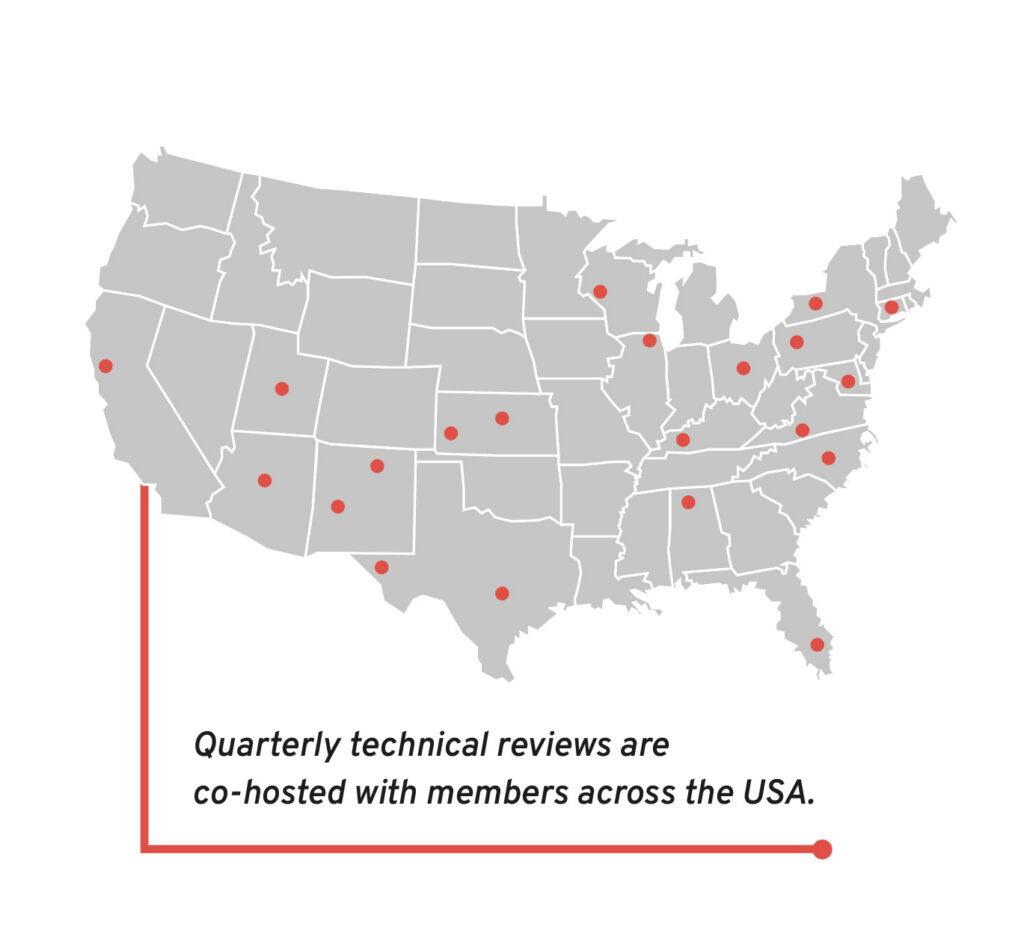
The AMC is focused on bringing together a diverse group of industry, small business, government, and academic stakeholders to develop projects and recommendations that have the potential to significantly impact the state of the art in AM. This is accomplished through joint industry and government projects, technology demonstrations, and quarterly meetings. Membership is required to participate, there are three tiers of membership: large businesses including OEMs, small businesses encompassing technology, material, and service providers, and not-for profit research partners. For more information on how to join contact AMC director Ed Herderick at eherderick@ewi.org or 614-688-5111.