
Submerged arc welding (SAW) is a high deposition rate process when compared to gas metal arc welding (GMAW) or gas tungsten arc welding (GTAW). Certain applications such as large flat panels, girth welds in pipe, or spiral pipe mills can benefit from techniques used to increase the deposition rate, and consequently, the productivity of the SAW process. A few of these techniques are increased stickout welding, twin wire welding, and tandem welding.
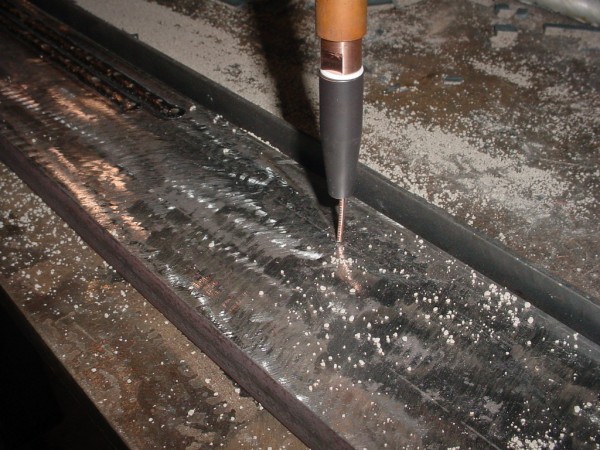 Increased stickout welding operates on the principle that an increased amount of the welding current will be used to preheat the welding wire due to the increase in electrical resistance created by using a long stickout. The rate of preheating behaves according to the I2R relationship, where I is the welding current and R is the resistance of the welding wire from the contact point to the arc. The benefit achieved by taking advantage of this electrical behavior is an increase in wire feed speed for a given current level, which translates to higher deposition rates. Commercial products made of non-conductive materials are available to provide consistent electrode placement when welding with a long stickout technique.
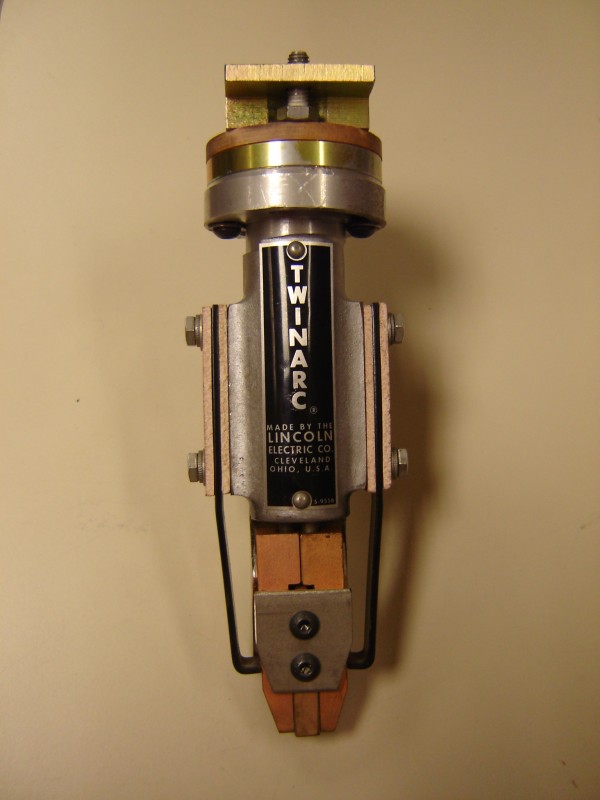
Twin wire welding provides increased deposition rates by feeding two electrodes into the same weld pool. With twin wire, both electrodes are fed using a single wire feeder that has a third drive roll mounted on the shaft to create an additional groove for feeding the second wire. Both wires are fed at the same speed and have the same electrical potential. The spacing of the electrodes can be changed by using different contact blocks.
Tandem SAW uses multiple independent arcs operating in the same weld pool oriented in-line with the direction of travel. Up to five arcs could be applied in tandem to achieve substantially increased deposition rates. The benefit of Tandem operation is the ability to control all of the arcs independently. Each arc could operate at different welding conditions or even using different polarity. Tandem SAW welding with two arcs is commonly applied using DC + on the lead arc to achieve penetration and AC or variable polarity on the trail arc for increased deposition.
Please feel free to contact me if you are interested in increasing productivity by using submerged arc welding. I can be reached at 614.484.7600or by email at [email protected].
Here are a few other articles related to increasing productivity with arc welding processes: